

Every year, thousands of Indians start Googling the Canada PR process for Indians without first looking at their own profile. They jump straight to point calculators, draw numbers, and pathway names. But rules mean little until you know where you stand.
Age, education, work experience, and language skills shape your options long before any pathway does. Here we walk you through reading your profile first, so the Canada PR process for Indians actually makes sense for your situation, not just in theory.
Establishing the Applicant Profile Before Pathway Selection
Before you touch a single eligibility rule, sit with your own facts. Here’s what actually forms the base of your profile.
- Age Factor – Points drop steadily after 30, so your age bracket changes, which pathways suit you best.
- Education Level – A bachelor’s, master’s, or diploma each carries different weight once assessed.
- Work Experience – Years in your field matter more than the job title on your card.
- Language Scores – Your IELTS or CELPIP band decides a big chunk of your total points.
- Family Situation – A spouse’s education and work history can add or reduce your combined score.
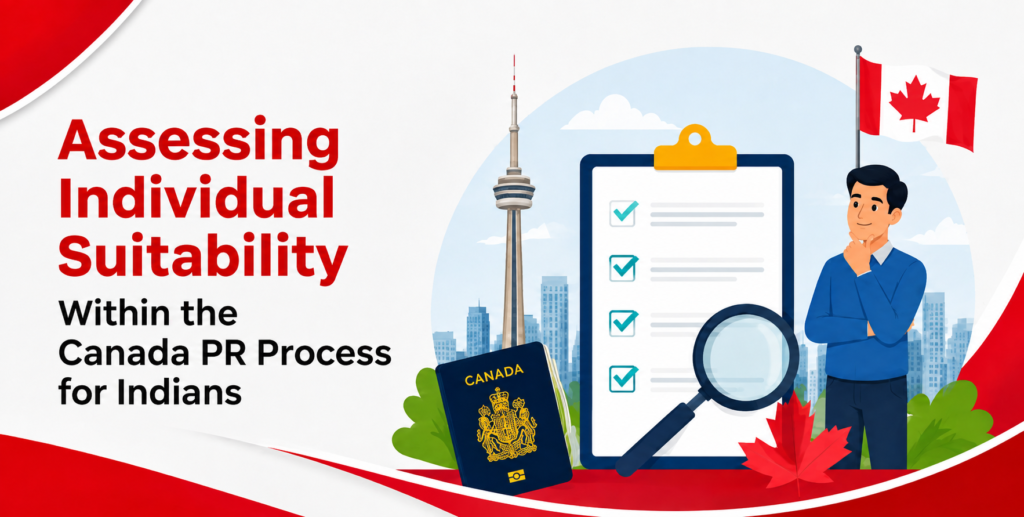
Assessing Individual Suitability Within the Canada PR Process for Indians
Once your profile is clear, the next step is checking where you actually fit. This is where many applicants get ahead of themselves.
- Skill Match – Your occupation needs to align with Canada’s in-demand job categories.
- Job Offer – A valid Canadian job offer can boost your ranking, though it isn’t compulsory.
- Settlement Funds – Proof of funds shows you can support yourself before your first paycheque.
- Adaptability Factors – Past visits, relatives in Canada, or Canadian study history all add small but real value.
Suitability isn’t about ticking boxes. It’s about seeing how your real-life profile behaves inside the Canada PR process for Indians, not how it looks on paper.
Interpreting Credentials Within the Complete Profile
Your degrees and certificates only mean something once they’re read correctly against Canadian standards.
- ECA Reports – An Educational Credential Assessment translates your Indian degree into Canadian terms.
- Degree Weightage – A three-year bachelor’s often scores differently than a four-year one.
- Experience Proof – Reference letters need exact duties, hours, and dates, not vague job descriptions.
- Test Scores – Even a small language score jump can shift your CRS band noticeably.
This step alone can make or break the Canada PR process for Indians, since a poorly worded reference letter or an outdated ECA can quietly cost you points.
Distinguishing Eligibility From Immigration Competitiveness
Here’s a mistake we see often at Arezou Globe: applicants assume meeting the minimum means they’ll get picked. Eligibility and competitiveness are two different things.
- Minimum Requirements – This just means you’re allowed to apply, nothing more.
- CRS Ranking – Your actual score decides your place in the pool.
- Draw Cutoffs – Recent draws show cutoffs shift often, so timing matters.
- Profile Strength – Two eligible candidates can have very different real chances.
Understanding this gap is often what separates a smooth Canada PR process for Indians from months of confusion.
Assessing the Strategic Relevance of Different PR Pathways
Not every pathway fits every profile. A quick comparison helps:
| Pathway | Best Suited For | Key Factor |
| Express Entry | Skilled workers with strong CRS scores | Language + education points |
| Provincial Nominee Program (PNP) | Applicants with lower CRS but a specific province connection | Provincial job demand |
| Family Sponsorship | Those with close relatives already settled in Canada | Relationship proof + sponsor eligibility |
Quick profile-to-pathway map:
- Strong English/French + high education → Express Entry
- Regional job offer or provincial ties → PNP
- Spouse, parent, or child in Canada → Family Sponsorship
This is exactly why working with the best consultant in India for Canada immigration helps — they map your actual profile to the right pathway rather than a generic one, which makes the Canada PR process for Indians feel manageable rather than overwhelming.
Frequently Asked Questions
1. What is the Canada PR process for Indians in simple terms?
It’s the step-by-step system in which your age, education, experience, and language scores are converted into points and then compared with those of other applicants in the pool. Understanding the Canada PR process for Indians this way removes a lot of guesswork.
2. How do I find the best consultant in India for Canada immigration?
Look for consultants who assess your profile first, explain realistic outcomes, and never promise guaranteed results. Searching for a Canada PR consultant near me with a proven track record is a good starting point.
3. Should I choose a Canada visa consultant near me or an online-only service?
A local consultant, especially among trusted Canada immigration consultants in Delhi NCR, can offer document verification and follow-up support that online-only services often can’t.
Looking for a Canada PR consultant near me who reads your profile before quoting rules? Arezou Globe, counted among the top 10 immigration consultants in Delhi, offers honest, profile-first guidance for your Canada PR process for Indians journey.



Leave a Reply